

 Adam P Rusch
 William Cope
 Jason Berg
.png "Rita van Haren") Rita van Haren
Rita van Haren Eric Patnoudes
 Maura Rodgers Brand
 Jason Williams
 Melanie Lamus
 Heather A Ochman
 May Thet Khine Nyein
e-Learning Ecologies MOOC’s Updates
Applying Collaborative intelligence concepts in Architecture Learning though Design Phases
Intelligence is our capacity to reach for always-available social memory and to apply available logics and computational tools. It is what we can do together in communities of practice. Today, through ubiquitous computing and the social web, externalized memory and computational tools are accessible that have historically unprecedented power. At the same time, work, public and community life is more manifestly energized by collaborations. (Kalantzis & Cope, 2015).
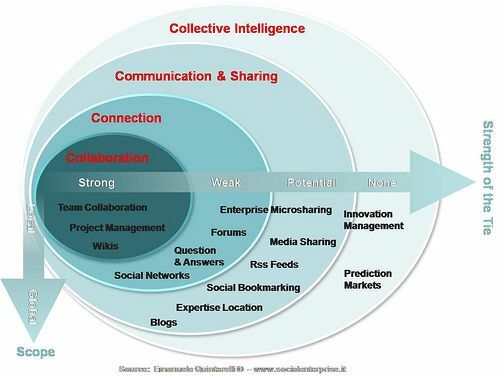
Fig 1: Collaborative intelligence
Source: Eric Delcroix- Enterprise 2.0 Framework
We need also to know more about collaborative intelligence where the knowledge of a working group is greater than the sum of its individual members. We now have analyzable records of social knowledge work, recognizing and crediting for instance the peer feedback that made a knowledge construct so much stronger, or tracking the differential contributions of participants in a jointly created work. In these ways, artefacts and the processes of their making may offer sufficient evidence of knowledge actions, the doing that reflects the thinking, and practical results of that thinking in the form of knowledge representations. (Kalantzis & Cope, 2015).
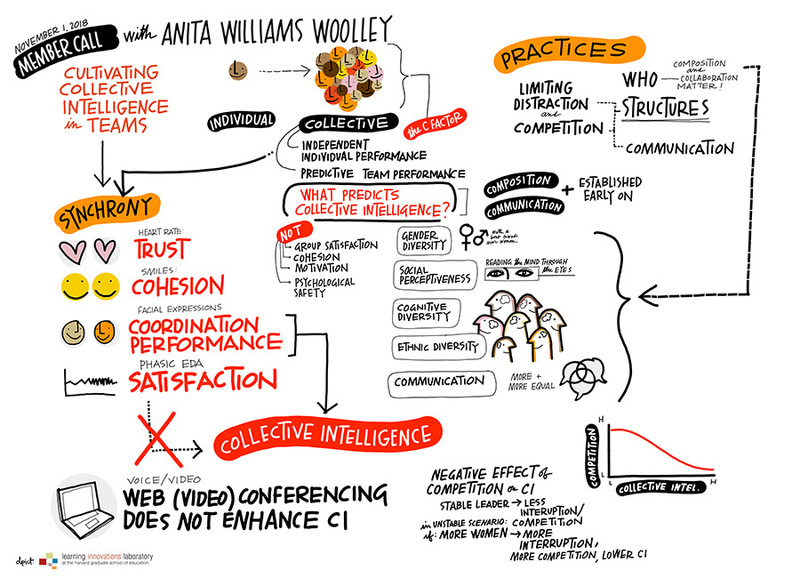
Fig 2: How can we measure collective intelligence in teams
In Architecture Design Studio, Community and collaboration tools, Peer-to-peer learning, Collective intelligence are widely applied. Students assemble their knowledge representations in the form of rich, multimodal sources. For example, in the first phase of the design project, the students perform the cases study analysis for similar projects. In that phase they combined their work in the form of text, image, diagram, table, audio, video, hyperlink, info- graphic, and manipulable data with visualizations analysis. These are manifestly the product of multimedia learning and distributed cognition, where the knowledge production process is as important as the product itself.
The second phase of the design project which is the (site analysis) that required site visit which is usually performed through group work. During this phase students practice recursive feedback and collaborative intelligence concepts which are associated here through the several used sources; peer feedback during the making, and collaboratively created works during the site visit and the site analysis tasks afterward. This offers evidence of quality of disciplinary practice, collaboration, developing students’ capacity to discover secondary knowledge sources, and create primary knowledge from observations and through manipulations. The artefact of both phases is identifiable, assessable, and measurable and Its provenance is verifiable. Every phase in the project construction can be traced. The tools of measurement of artefacts are also expanded – drawings processing, time-on-task, peer- and self-review, peer annotations, edit histories, navigation paths through sources. In these ways, the range of collectable knowledge surrounding the project work is hugely expanded.
References:
Eric Delcroix, Enterprise 2.0 Framework, Retrieved on August 17th from: https://erdelcroix.tumblr.com/post/19350330691/cyberlabe-enterprise-20-framework
Kalantzis, Mary and Cope, Bill, 2015, Learning and New Media, book chapter 35, The SAGE Handbook of Learning. P 382-383.
Learning innovations laboratory, How can we measure collective intelligence in teams?, Hrvard graduate school of education. Retrieved on August 17th from: https://www.learninginnovationslab.org/can-we-measure-collective-intelligence-in-teams/


