

 Adam P Rusch
 William Cope
 Jason Berg
.png "Rita van Haren") Rita van Haren
Rita van Haren Eric Patnoudes
 Maura Rodgers Brand
 Jason Williams
 Melanie Lamus
 Heather A Ochman
 May Thet Khine Nyein
e-Learning Ecologies MOOC’s Updates
Virtual Reality (VR) as a new concept of Multimodal Meaning
While ‘Media’ bridge the ontogenesis and phylogenesis of knowledge, yet, to return to the etymology of the word, media are used as middle-objects, conditions or technologies that facilitate human communication, between one and one, one and many, or many or many. Media are agents of cultural ‘between-ness’. They bridge spatial separations, so that people not in each other’s immediate physical presence can connect. They bridge time, so ideas, information and cultural representations from another time (a minute ago or a century ago) can be re-heard and re-seen. (Kalantzis & Cope, 2015).
Media, in other words, are material means for the production and distribution of meanings across space and time. However, the forms of media have changed fundamentally across the long arc of human history. One such transformation, beginning half a millennium ago with the invention of print, was the mechanical reproducibility (Benjamin, [1936] 2008) of human communications. With it came a whole communicational infrastructure of typographic culture (Eisenstein, 1979) – books, libraries, newspapers, schools.
The twentieth century saw a cascading series of transformations around photographic reproduction and its derivatives – cinema, television, photo-lithographic printing. In the twenty-first century, we now find ourselves in the midst of a new series of transformations, centered around the digitization of text, image, sound and data and the global interconnection of these digitized meanings through the medium of the internet. This latest phase in the development of media, we call ‘new media’. These media relations were aligned with the epistemic relations of ‘didactic pedagogy’ (Kalantzis and Cope, 2012b). The new media and social media are by comparison ‘participatory’ (Haythornthwaite 2009; Jenkins, 2006).
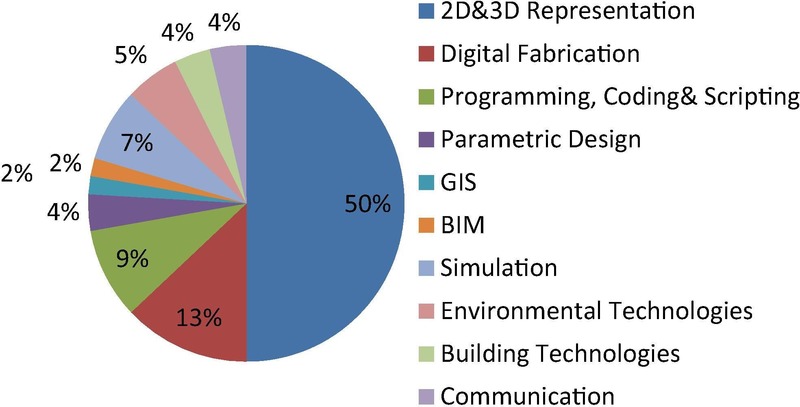
Fig. 1. Computer application disciplines in the international level. (Soliman, Taha, Sayed, 2019)
However, technologies do not in themselves change anything in education. However, we also want to suggest that new media offer a number of pedagogical openings, or affordances. Changing the medium does not necessarily change the message. In finely grained analysis, Hattie reveals that although computers do not themselves lead to improved learning outcomes, specific applications of computers can. (Hattie, 2009: 222–7).
In this regard, applying in Architectural Education, most, if not all, of the media concepts are used in teaching architectural design. Through which, students are being introduced to multimedia concepts like, digital media, multimodal knowledge representations, visual learning, video learning, simulations along their studio levels starting from junior level and up to the senior class and graduation/ capstone studio.
However, over the past few years technologies like “Augmented reality” and “Virtual Reality”, as a new raising technology was adapted in many Architectural schools around the world, sometime as a solid part of the program and sometimes as an individual desire of the learner.
Virtual Reality (VR) is the use of computer technology to create a simulated environment. Unlike traditional user interfaces, VR places the user inside an experience. Instead of viewing a screen in front of them, users are immersed and able to interact with 3D worlds. By simulating as many senses as possible, such as vision, hearing, touch, even smell, the computer is transformed into a gatekeeper to this artificial world. The only limits to near-real VR experiences are the availability of content and cheap computing power. (Marxent labs, 2020)

Fig 2. Augmented Reality & Virtual Reality, Glass up, 2018
In that essence we can claim that VR is sharing the same grounding for this multimodality as identified by (Kalantzis & Cope, 2015) to be a practical, material, tangible, a product of industrial design even before reaching the consumer.
These modes are all made of the same material stuff, text and image of pixels, and one layer behind that, sound and manipulable data as well in common binary encodings. This is how we can manufacture all these meanings in the one recording and dissemination device. This device, a phone, a tablet, a laptop becomes a cognitive prosthesis for the purposes of both representation (lending sup-port to our thinking-for-ourselves) and communication (defying distance by connecting us through tele present messaging-for-others).
References:
Augmented Reality & Virtual Reality, retrieved August 4th 2020 from: https://www.glassup.com/en/augmented-reality-virtual-reality
Hattie, J. (2009) Visible Learning: A Synthesis of Over 800 Meta-Analyses Relating to Achievement, London: Routledge.
Kalantzis, Mary and Cope, Bill, 2015, Learning and New Media, book chapter 35, The SAGE Handbook of Learning. P 373-379.
Kalantzis, M. and Cope, B. (2012b) New Learning: Elements of a Science of Education, Cambridge, UK: Cambridge University Press. https://www.marxentlabs.com/what-is-virtual-reality/
Sara Soliman, Dina Taha, Zeyad El Sayad, Architectural education in the digital age: Computer applications: Between academia and practice, Alexandria Engineering Journal, Volume 58, Issue 2, 2019, Pages 809-818, ISSN 1110-0168, https://doi.org/10.1016/j.aej.2019.05.016. retrieved August 4th 2020 http://www.sciencedirect.com/science/article/pii/S1110016819300602


